
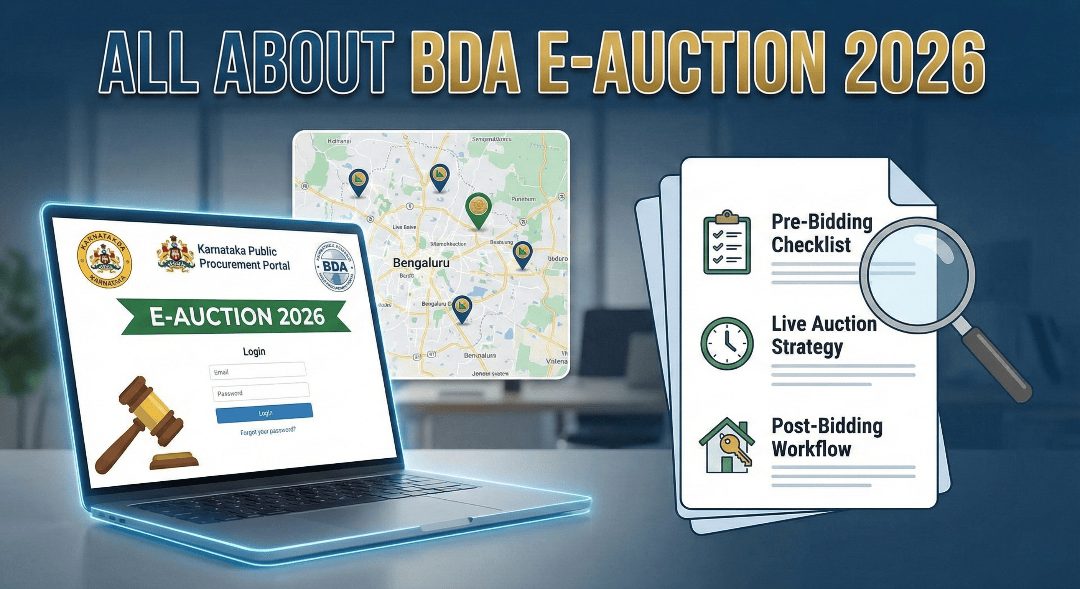
For many residents of Bengaluru, owning a BDA (Bangalore Development Authority) site is the ultimate real estate dream. BDA plots offer clear titles, planned infrastructure, and incredible appreciation potential.
However, most people associate getting a BDA plot with the traditional “draw of lots”—a lottery system based on seniority and multiple attempts. While that is the primary mode of allotment for social housing, there is another, faster, and more direct route to acquiring prime land directly from the authority.
If you have capital ready and are looking for premium real estate without the wait times of the lottery system, understanding the BDA e-auction is crucial. Here is a breakdown of how it works, based on the established legal framework.
BDA Allotments
It is important to first understand that under the Bangalore Development Authority (Allotment of Sites) Rules, 1984, e-auctioning is not the standard way the BDA distributes land. The statutory framework is primarily designed for allotment through applications and a lottery draw to ensure fairness in urban development and social housing.
The BDA e-auction is legally permitted only as an exception to these rules. This route is specifically designed to achieve transparency and optimal revenue realization for the authority, rather than social housing goals.
What Kind of Sites Are Auctioned?
If the regular plots go to the lottery, what ends up in the e-auction? The inventory generally falls into two categories:
1. Stray Sites
These are sites that have “fallen through the cracks” of the regular process. They include:
- Sites that remained unallotted during regular drives.
- Plots surrendered back to the BDA by original allottees.
- Sites cancelled due to violations of allotment conditions.
- Plots where repeated attempts at regular allotment have failed.
2. High-Value Sites
These are the jewels in the BDA crown. They are plots not intended for social housing because of their premium nature, such as:
- Corner sites: Plots at the intersection of roads, offering better access and ventilation.
- Commercially advantageous plots: Sites located on main roads or near commercial hubs.
Because of their high potential value, these sites are deemed suitable for auction to generate revenue for infrastructure development.
Legal, Digital, and Transparent
The legal authority for these auctions flows directly from Sections 65 and 69 of the BDA Act, 1976, along with subsequent government orders. Courts have consistently upheld the validity of these auctions, provided the process remains fair and in the public interest.
In the modern era, the entire process has moved online. Gone are the days of crowded auction halls. Today, the process is conducted exclusively through a secure, dedicated e-procurement platform.
This digital structure is a game-changer. By combining wide public notifications with a secure online bidding system, the BDA ensures fair competition and eliminates the scope for arbitrariness or favoritism that could plague physical auctions.
The Critical “Fine Print”
While the e-auction is a reliable mechanism given Bengaluru’s soaring real estate demand, potential bidders must be aware of one crucial condition.
All sites offered under the BDA auction are disposed of on an “As Is Where Is” basis.
This means that once you win the bid and receive your allotment letter, you accept the site in its current physical condition, subject to applicable terms. It is highly recommended that prospective bidders physically inspect the site location before participating in the auction.
A Structured Approach
To make the process easier to understand and comply with, the BDA e-auction is broadly structured into two organized stages:
- The Pre-Bidding Process: Registration, paying the earnest money deposit (EMD), and verification.
- Post-Successful Bidding Formalities: Payment schedules and issuance of the allotment letter.
Pre-Bidding Process for BDA E-Auction
The pre-bidding stage involves all preparatory actions a participant must complete before and
during the e-auction process announced by the Bangalore Development Authority (BDA). The
following steps describe the process in detail:
- Publication of E-Auction Notification
The BDA releases an official notification on BDA portal announcing the commencement of an e-auction for residential or commercial plots.
This notification includes important details such as plot numbers, locations, base prices,
eligibility criteria, and auction dates. Interested participants should carefully review this
notice to identify potential plots. - Verification of Geo-Tagged Locations & Site Visit
Once the geo-tagged layout map is available on the BDA portal, the participant should
locate and visit the property of interest.
A physical site visit helps verify the exact plot location, surroundings, accessibility, and
on-ground measurements. - Plot Identification
During the site visit, note down the correct plot number and ensure it matches the details
mentioned in the BDA notification and layout plan.
This step is crucial for avoiding errors during application submission. - Creation of E-Procurement Credentials
The next step is to create login credentials on the Karnataka E-Procurement Portal
(https://eproc.karnataka.gov.in).
This registered account is mandatory for participating in the BDA e-auction process. - Review of Auction Terms & Conditions
Before proceeding further, carefully go through all auction rules, terms, and payment
schedules as published in the e-auction document.
Pay attention to points related to eligibility, EMD (Earnest Money Deposit), bid
increments, and payment timelines to ensure compliance. - Filling the E-Auction Application
Log in to the e-procurement portal using your credentials and fill out the e-auction
participation form with accurate personal and property details.
Ensure that the chosen plot number and details correspond exactly to your site
inspection. - Uploading Required Documents
Upload all required notarized documents such as ID proof, PAN card, address proof, and
any other documents specified by the BDA in the auction notice.
These documents must be scanned clearly and in the prescribed format. - Payment of Bid Participation Fee
Make the non-refundable bid participation payment (as per the amount mentioned in the
BDA notification).
This fee allows you to participate in the auction process for the selected plot. - Payment of Earnest Money Deposit (EMD)
Proceed to pay the Earnest Money Deposit (EMD) of Rs 4 lakh through the e-procurement portal.
The EMD amount is refundable in case the bidder is not successful in the auction. - Participation in Live Bidding
On the scheduled bidding date and time, log in to the e-auction portal to participate in
the live auction.
Submit bids within the specified time window and bid increments of ₹500/sqm as per the BDA auction rules. - Allotment to the Highest Bidder
After the auction closes, the system automatically declares the highest bidder for each
plot.
The highest bidder is considered the successful participant and becomes eligible for post
bidding formalities and payment procedures
Post-Successful Bidding Formalities
After being declared the highest bidder in the BDA e-auction, the following formalities must be
completed to secure ownership and finalize the registration of the allotted plot.
- Payment of 25% of Bid Value
The successful bidder must remit 25% of the total bid amount (including the EMD) within
the stipulated period mentioned in the BDA auction notice.
Failure to make this payment within the timeline may lead to forfeiture of the bid. - Submission of Documents & Acknowledgment
The bidder must submit all required documents and payment receipts to the concerned
BDA section and obtain an official acknowledgment confirming the submission. - Follow-Up for Allotment Letter
The bidder should continuously follow up with the BDA Allotment Team to collect the
official Allotment Letter, which confirms the plot allotment in the bidder’s name. - Initiate Bank Loan Process (if applicable)
If the bidder intends to avail a bank loan, they should initiate the loan application
immediately after receiving the allotment letter and coordinate with the bank for
document submission and verification. - File Submission to Deputy Secretary’s Caseworker
All necessary documents, including the allotment letter, payment proofs, and ID
documents, must be submitted to the respective Deputy Secretary (DS) caseworker, who
will open a file for processing. - Coordination Between Bank & BDA
The bidder should coordinate closely with both the bank and the BDA caseworker to
ensure smooth communication, document validation, and timely approvals during the
loan and registration process. - Follow-Up with Caseworker
A thorough follow-up must be maintained with the assigned caseworker to monitor the
progress of documentation, file movement, and internal verifications. - Verification by Deputy Secretary
Once the documentation is complete, the Deputy Secretary (Land Section) will verify all
submitted documents, ensuring compliance with BDA’s legal and procedural norms. - Sale Deed Drafting
The sale deed must be drafted as per BDA’s official format and guidelines, incorporating
accurate details such as plot number, bidder name, bid amount, and allotment reference. - Encumbrance Certificate (EC) Generation
Before registration, an Encumbrance Certificate (EC) should be generated and verified to
confirm that the property is free of any legal encumbrances. - Payment of Registration Fee
The bidder must pay the applicable registration fee as prescribed by the Sub-Registrar
Office (SRO) for property registration. - Scheduling Registration Appointment
In coordination with the BDA caseworker, the bidder should schedule an appointment
with the respective Sub-Registrar Office for property registration. - Execution of Sale Registration
On the scheduled date, the bidder should visit the Sub-Registrar Office and execute the
sale registration, completing the legal transfer of ownership. - Post-Registration Formalities
1. Apply for Updated Encumbrance Certificate (EC) to reflect the new ownership.
2. Apply for e-Khata transfer in the bidder’s name.
3. Apply for Possession Certificate through BDA confirming physical handover of
the property.
4. Make Property Tax Payment at the local municipal office or through the online
portal to update ownership in civic records.
The BDA e-auction is a transparent and structured process, but it requires careful planning, timely payments, and diligent follow-ups. By understanding both the pre-bidding steps and post-successful bidding formalities, participants can confidently navigate the process and secure BDA-allotted properties without delays or errors.
FAQs
The BDA e-auction is an online land allotment process conducted by the Bangalore Development Authority through a secure e-procurement platform for selling residential, commercial, corner, and intermediate sites in Bengaluru in a transparent and competitive manner.
Any Indian citizen, individual buyer, partnership firm, or eligible entity can participate in the BDA e-auction. Minors or individuals without computer knowledge may participate with the assistance of a guardian or authorized representative.
In the BDA e-auction, sites are offered on an “As Is Where Is” basis, meaning the plot is allotted in its existing physical condition. Bidders are advised to conduct a physical site visit before bidding.
The EMD amount is ₹4,00,000 per site. This amount is refundable if the bidder is unsuccessful in the auction.
The minimum bid increment is ₹500 per square metre, as specified in the BDA auction rules.
While not mandatory, a physical site visit is strongly recommended to verify the plot location, access roads, surrounding development, and measurements before bidding.
After being declared the highest bidder:
1. You must pay 25% of the total bid value within the stipulated timeline.
2. Submit required documents to BDA.
3. Obtain the Allotment Letter.
4. Complete sale deed registration through the Sub-Registrar Office.
Yes, bank loans are permitted after the Allotment Letter is issued. The bidder must coordinate between the bank and BDA for documentation and approvals.
Commonly required documents include:
ID proof
PAN card
Address proof
Bank details
Any additional documents specified in the auction notification
After sale registration, bidders must:
1. Apply for updated Encumbrance Certificate (EC)
2. Apply for e-Khata transfer
3. Obtain Possession Certificate from BDA
4. Pay property tax to update civic records
Disclaimer: Procedures and timelines are subject to change as per BDA notifications. Participants are advised to verify details on the official BDA portal.

Join The Discussion